|
DEAN
HARTLEY The Stories, Science, and Speculative Science in the Persistence of Vision Series |
|
  Ross & Leanne George & Chrissy
Carl and Brandy
Frank and Peggy
Barbara and Joe
JJ and Doug
|
We will use Dr. Ruth Kastner’s explanation of the
Transactional Interpretation (TI) of Quantum Mechanics, as described in her book
Understanding Our Unseen Reality: Solving Quantum Riddles
The first part is the view of reality – our “now” as being
created from the past by quantum events, such as the absorption of a photon by
an electron.

Based on the nature of quantum physics, which to date has
an extremely high theory-to-experimental-test ratio (meaning the theory predicts
observed events very well), we can say the following:
The past consists of a fixed set of quantum events, which collectively
present themselves as macroscopically observable events.
The present is the result of quantum interactions that were
probabilistically predictable, not deterministically predictable, from the
past.
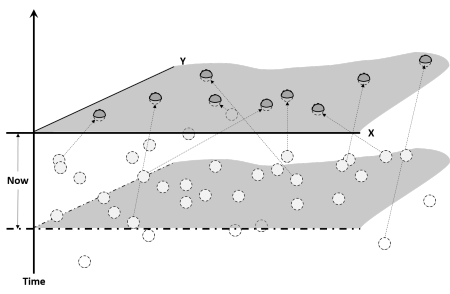
The future is indeterminate. In , we could not display the
future as consisting of events that we will get to after time passes.
In fact, the TI says that both space
and time are created by the occurrence of events and there is no future –
yet.
The second part of the explanation that is relevant to this
novel is the concept of “quantumland.”
We observe the three spatial dimensions and time with our human senses.
We now take for granted that there are real things that are too small for
us to see, such as germs, atoms, protons, and electrons, and that there are
forces that act on us and other things that are perceptible only through their
actions, such as magnetism, electrostatic forces, and electromagnetic
waves/photons.
The quantum theory that describes the nature of some of
these invisible things involves truly difficult mathematics and predicts some
remarkable and non-intuitive results.
The mathematics are clear (well clear to some people), but wrapping your
head around the reasoning is not clear.
In fact, there is more than one “interpretation” or way of understanding
quantum mechanics. Understanding is
not required for cranking through the calculations and getting the results, but
scientists really want to understand what is going on.
The TI is one such interpretation, and according to Kastner, the best.
One way of looking at the problem is to consider a photon
of light. A photon is the smallest
quantity of light energy possible – it is a quantum of energy.
Unfortunately, light has a dual nature.
Sometimes it acts like particles – quanta – and sometimes it
acts like electromagnetic waves.
However, at all times it has a unitary nature, it’s just that our method of
description has to change to fit the circumstances.
Let’s consider an anthropomorphized electron.
For some reason, it wants to get rid of some energy by emitting a photon
of light. Apparently, it can’t just
send the photon off into space, perhaps to travel forever.
Instead, there must be a home for the photon, such as another electron
that can use the extra energy.
Imagine the photon as a wave expanding at the speed of light from the original
electron. As the wave expands, it
encounters other electrons, but none that can use that particular photon.
Finally, the wave encounters another electron that can use the photon.
The second electron is at a given distance and direction from the
original electron. Now, go back to
the time of the original electron emitting the wave, but instead imagine the
electron emitting a photon in the precise direction of the second electron.
The photon travels at the speed of light and arrives at the second
electron after an amount of time, T, determined by the distance.
The second electron absorbs the photon.
Both electrons are happy.
In the first picture, the expanding wave encountered the
second photon at one point of the sphere representing the wave front.
Given the constant speed of light and the distance between the two
electrons, this would be at a calculable time, T, after the emission.
We could have said the second electron absorbed the quantum of energy –
the photon – then. But what happened
to the rest of the sphere of the wave front?
It represented the entire quantum of energy, of which there is no smaller
part. In the second picture, how did
the first electron know what direction to send the photon?
In an attempt to resolve these questions, let’s combine the
pictures. The first electron emits
an expanding wave at light speed – let’s call it an “offer wave.”
When the offer wave hits the second electron, it responds with a
“confirmation wave.” When the
confirmation wave gets to the first electron, it emits a photon in the precise
direction indicated by the confirmation wave.
We now have a way for the quantum of energy to be emitted from the first
electron and absorbed by the second.
Unfortunately, our offer wave took time T to get to the second electron and the
confirmation wave took time T to get back.
Then the photon takes time T to travel from the first electron to the
second electron. A total of 3T time
is required. This doesn’t fit
observations or theory. The solution
is simple – the confirmation wave travels backward in time, so it reaches the
first electron at time zero. This
makes the total elapsed time to be T, which fits observations and theory.
However, it leaves a small problem of a wave going backward in time.
TI solves this with quantumland.
The offer wave and the confirmation wave do not travel in our physical
space-time. They exist in
quantumland, which does not have space or time.
Quantumland is a multi-dimensional Hilbert space.
You can look up the definition, but basically it is a space that allows
for the right kinds of actions.
Further, since we don’t have waves going backward in time, we see the quantum
events as creating our normal space-time as they occur.
The third salient part of TI involves quantum randomness.
In the example above, there was only one electron willing to accept the
photon. In general, there will be
multiple possible absorbing electrons, each sending a confirmation wave in
quantumland. The physical situation
will make some of the possible absorptions more probable than others.
However, only one transaction will occur because there is only one photon
involved and it cannot be subdivided.
These probabilities are part of standard quantum theory and are
well-defined – but they are probabilities and the “choice” is truly random.
We will use this in the novel.
From a particular viewpoint, we can ignore relativity and
talk about simultaneous events – that is events that can be calculated to have
occurred at the same time, based on their distance from the viewpoint and the
constancy of the speed of light. For
a particular time, the simultaneous events are shown in the upper plane of the figure below.
The figure depicts these events, which constitute the “present time,” as
being created from past events.
These events are insufficient to define “reality.”
.png)
However, we do not perceive picosecond or nanosecond or
even millisecond intervals. We lump
some of the events of the past into our perceived reality.
Hence, our perceived “now” is actually an interval that extends from the
present into the past. For natural
human perception, the extent of this interval is on the order of 0.05 to 0.1
seconds.
The brain is clearly part of space-time and there is plenty
of evidence that it is involved in human thinking.
However, we have yet to establish what consciousness (the mind) is and
how it is associated with the brain.
Philosophically, we have a question about free-will and determinism.
We have the impression that we have free-will, but we also have evidence
that there are many influences that affect our choices and no theory that allows
for choices beyond these influences.
We do know that all of the activities in the brain
ultimately relate to quantum events, such as photon exchange between electrons.
It is a leap, but perhaps not too much of one, to posit that the mind
resides in quantumland, connected to the brain through quantum events.
We do that in the novel. With
the mind in quantumland, many connections are possible, both between the mind
and other physical systems and between minds.
We explore some of these.
In a more detailed book, Ruth Kastner tells how TI solves
the problem of a predetermined future as implied by some interpretations of
relativity
Kastner, R. (2019). Adventures in
Quantumland: Exploring Our Unseen Reality. London: World Scientific.
Kastner, R. E. (2013). The Transactional
Interpretation of Quantum Mechanics: The Reality of Possibility.
Cambridge: Cambridge University Press.
Kastner, R. E. (2015). Understanding our
Unseen Reality: Solving Quantum Riddles. London: Imperial College Press.
 Return to Dean Hartley Science Fiction
Return to Dr. Dean S. Hartley III Entrance